
Beekeeping in November


Brian Fackler – Cornell University Master Beekeeper

November is a quiet time for the bees. It is possible for the bees to do some late season forage on a mild sunny day. Brood rearing will have essentially ceased making the demands on the colony much less and activities levels will be lower. Cleansing flights will take place when weather conditions permit otherwise the colony does very little.


Winter Bees: With the demands on worker bees reduced they store fats and proteins thus their fat bee longevity. With reduced activity the metabolic rate is lower. When the temperature drops below 64f they will start to form small clusters. At 32f the cluster is as tight as it will get, with the center of the cluster as low as 55f. The center of the cluster is not so tight and be bees are able to move around, feed and vibrate wing muscles to generate heat. They regularly swap places in order so all can feed. Do not disturb or break the cluster if possible.


Winter Winds: If your hives are not protected by trees or a fence consider bales of straw bales or other method to block the weather. To the top of your hive add a cinder block, large rock or strap hives down. Your bees have worked hard to seal cracks and opening with propolis so don’t open your hives unless necessary. If you need to wrap your hives with tar paper or other methods, do it prior to Thanksgiving.

Winter Feed: If you are concerned you may not have sufficient honey stored install a candy board which can be purchased from Dadant or other suppliers. Watch the video instructions from Weller Bee Supply “Candy Boards and Preparing Your Hive for Winter” – https://wellerbeesupply.com. Make fondant and or sugar patties with recipes from Lane County Beekeepers – https://www.lcbaor.org. Only use 100% plain white granulated sugar and not organic or brown sugar. Checking for starvation or adding emergency feed can be done from the hive top. Do not add pollen patties as this encourages the queen to lay eggs. One of the most important winter chores is to lift the hive body from the bottom to check if it’s light in weight and likely low in honey stores. Also, on a favorable weather day you can open the lid for a very brief peek. Your bees will starve if they consume all of their honey reserves or they move to the edge of the hive where they no longer contact honey frames.

Varroa Mites: At temperatures of 50 f or lower do not open your hive unless necessary and consider if needed treatment and sampling methods using oxalic acid vapor and screen board for mite sampling. Monitoring with a screen bottom board use a treatment threshold of five mites per day or lower. Effective times to treat are from Thanksgiving to Christmas.

Mouse Guards: If you haven’t done so already, be sure to put your mouse guards on – but make sure a mouse does not get trapped inside.  Look inside the entrance with a flashlight. If you do not see mouse nesting material on the bottom board, you’re probably okay. If you do, you need to remove it otherwise the mouse could cause severe damage over the winter.

Entrance and Queen Excluder: Your hive lower entrance needs reduced to the minimum and queen excluder removed.

Stored Drawn Comb: Storing drawn comb frames in the cold weather will kill wax moths at 20f.  In your freezer frames will kill wax moth and eggs in a few hours. Thuricide BT is a biological insecticide you can also spray on your frames and is formulated to kill young wax moth larvae as they attempt to feed on comb and must be used as a preventive before combs are infested. After the frames are prepared, store the drawn comb frames in sealed plastic bins or garbage sacks. It is heart breaking to see all the drawn comb ruined that your bees worked so hard to make.

Ventilating Hive: Involves removing the hive moisture with ventilation or capture with Vivaldi board or quilt box installed with moisture wicking materials. Upper entrance closed or open and Screen bottom board closed or open. Check for moisture on the bottom board and add a shim between the inner and outer cover if needed to reduce.

Condensing Hive: Mimics bee biology and what bees naturally create in a tree cavity. The temperature above the bee cluster must be maintained below the dew point. Less honey is needed stored in the hive by possibly 25 to 50%. The winter lower metabolic rate is maintained by keeping CO2 in the hive. Moisture is maintained in the hive as the bees consume only water diluted honey. The concept includes: insulation between inner and outer cover, no upper entrance, screen bottom board sample board fully inserted, wrapping and or sealing cracks and openings.

Reflection: This is the time of year to review your success and failures and develop a plan of action to level up your beekeeping for next year.
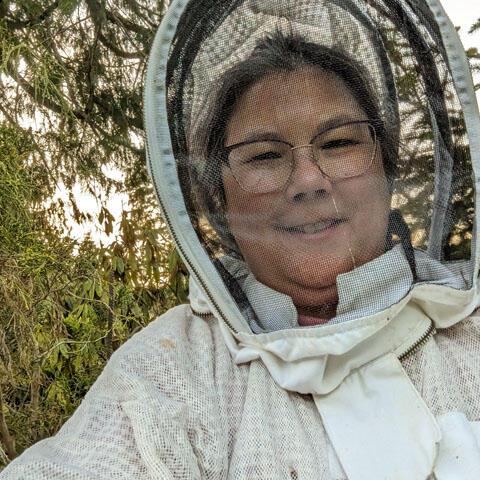
Spotlight on our Certified Masters

Jana Patterson, PUB Apiary Manager

Portland, OR – Certified 2025

Proficiencies: Three season pollinator gardening for honey bees and Oregon native pollinators; Honey Bee Pests and Diseases

Capstone Project: Developed and implemented a new honey bee program at a Beaverton School District high school. Students set up and learned how to manage their school apiary.

I got started with beekeeping in 2020. I started by reading Dewey Caron’s book before I got my nuc. I was intrigued that there was so much more to learn about bees than I had ever imagined. I found out about the OMB program and immediately enrolled.

I enjoyed all the learning in the apprentice and journey levels. For me, though, it all came together in the master level. I was able to combine my passion for bees, teaching/mentoring and giving back to the community in my capstone project. Having to teach others, both at the high school and as an OMB mentor, really solidified all that I had learned.

I’ve gained so much knowledge about honey bees and beekeeping. I know there is so much more to learn. After going through OMB, I now have the tools and connections to continue learning and growing as a beekeeper.

Congratulations recent graduates!

Apprentice

[OR] Radhika Marvin

Master – read about each Master graduate’s accomplishments here

[OR] Muffy Roy

[OR] Mike Standing

[UK] Tania Francis

Muffy Roy is a certified Master Level graduate

Please join us in congratulating Muffy! You can read about her experiences in the program here.

Location: Bend, OR

Proficiencies: Queen Rearing and Honey Bee Pests and Diseases

Capstone Project: 2024 Amitraz Efficacy Study at OSU

Oregon State Master Beekeeper Program

Dearth Season Hive Safety Reminder


This time of year, our bees are dealing with a nectar dearth — a sharp drop in available forage.
At the same time, yellowjacket activity increases, adding pressure as they attempt to rob
weakened colonies. Between reduced food resources and outside threats, even normally calm,
gentle colonies can become noticeably more defensive and aggressive.
With that in mind, this is an important time to:
 Inspect hives for varroa mites (an alcohol wash or sugar roll will give you an accurate
count)
 Treat for mites as needed, based on your inspection results
 Remove honey supers for extraction before treating, since most mite treatments should
not be applied with supers you intend to harvest still in place
Be Prepared for More Defensive Bees
Please take the following precautions during inspections:

  1. Fully close all zippers on your bee suit or jacket and pants — don’t leave any gaps.
  2. If wearing a fencing veil, wear a ball cap with a brim underneath it. The brim holds
    the veil away from your face, reducing the chance of a sting through the mesh.
  3. Wear boots or other sturdy, appropriate footwear.
  4. Expect your bees to buzz your face and attempt to sting. Stay calm, move
    deliberately, and don’t swat — but be mentally prepared for more assertive behavior than
    usual.
    Stay safe out there, and take extra care during inspections this season.

Beekeeping in October

Brian Fackler – Cornell University Master Beekeeper

In October, the days will start to be colder and the bees will not fly as much. The queen now is
laying fewer eggs and the entire colony is preparing for the cold winter months. Be sure to set
up your hive for winter before the end of the month. The decision to overwinter with moisture
control by either using ventilation or condensing both can each lead to success. Starvation and
moisture are the major factors in winter hive failure.

Mouse Guards
 If you haven’t done so already, be sure to put your mouse guards on – but make sure a
mouse does not get trapped inside.  During a hive inspection, look inside the entrance
with a flashlight. If you do not see mouse nesting material on the bottom board, you’re
probably okay. If you do, you need to remove it otherwise the mouse could cause severe
damage over the winter.

Feeding
 A general guideline is that one colony will need approximately 60 to 70 pounds of honey
to make it through winter. Weigh or heft you hives to make a determination of honey
stores.
 During the cold winter months consider winter patties, fondant and candy boards.
 If you’re worried that your bees will not have enough stores going into winter, feed them
1:1 sugar syrup, which mimics the nectar flow.
 2:1 sugar syrup when the weather starts getting cooler or you notice the nectar flow
tapering off.
 In warm weather syrup ferments quickly and to prevent this add 1 tsp bleach per gallon of
syrup or one tablespoon each of white vinegar and lemon juice.
 Avoid adding Honey-B-Healthy or ProHealth as this encourages robbing. If you do use
Honey-B-Healthy or ProHealth only use it only with an internal feeder.
 In mixing 2:1 syrup boil water first and remove from heat before adding sugar as you
might scorch the sugar which possibly can form HMF (5-hydroxymethylfurfural), which is
toxic to honeybees.
 Stop feeding sugar syrup when daytime temperatures are below 57 F

Preparing Hives for Winter
 Wrap or close all air gaps between the supers
 Reduce to winter hive size – two deep or three medium supers or less
 Remove the queen excluder
 Lower entrance to be reduced to a minimum size
 Remove any left behind varroa mite treatment

Ventilating Hive
 Involves removing the hive moisture with ventilation or capture
 Vivaldi board or quilt box installed with moisture wicking materials
 Upper entrance closed or open
 Screen bottom board closed or open

Condensing Hive
 Mimics bee biology and what bees naturally create in a tree cavity
 The temperature above the bee cluster must be maintained below the dew point
 Less honey is needed stored in the hive by possibly 25 to 50%
 The winter lower metabolic rate is maintained by keeping CO2 in the hive
 Moisture is maintained in the hive as the bees consume only water diluted honey
 The concept includes: insulation between inner and outer cover, no upper entrance,
screen bottom board sample board fully inserted, wrapping and or sealing cracks and
openings

Top Bar Hives
 Now is the time to start moving your bars and reorganizing them for winter.
 If you have a center entrance hive, that means moving them toward the center with your
follower board on either side of the hive entrance with all stores down to one side.
 Think about what you will use as a windbreak and make sure your mouse guards are on.

Varroa Mites
 With temperatures getting colder, treatment options for varroa are limited.
 Results of the PNW Honey Survey show that treating for varroa during the year made a
significant difference in survival rates.
 Sample your colonies for varroa mites and apply treatment as needed. Honey Bee
Coalition Tools for Varroa Management is your best guidance on sampling technique and
treatment options.
 Make sure you follow the recommendations precisely for the treatment you choose. Some
treatments can only be applied when honey supers are off while others need a certain
outdoor temperature. Check the extended weather forecast.
 After treatment, re-sample to make sure the treatment was effective. This is very
important and should not be overlooked.
 Going into winter it is critical you have your varroa mite levels and the viruses they carry
low enough or your winter bees will not survive till next spring.
 At temperatures of 50 f or lower do not open your hive and consider if needed treatment
and sampling methods using oxalic acid vapor and screen board for mite sampling.
 Monitoring with a screen bottom board use a treatment threshold of five mites per day or
lower.